When adding udon noodles to their menu, restaurants and distributors often face a common dilemma: should they choose dried or frozen? While the price listed on the purchase order is straightforward, factors such as storage requirements, preparation time, and portion usage—once the product is actually in use—determine whether the choice makes economic sense.
Start by Working Backward from the Service Scenario
If the business relies primarily on ambient-temperature distribution or has limited freezer space, dried udon noodles are a good option to try first. They integrate easily into existing dry-storage systems, though the boiling process requires advance planning. During testing, record the quantity per batch, cooking time, and post-cooking weight to ensure that poor preparation planning doesn’t slow down service during peak hours.
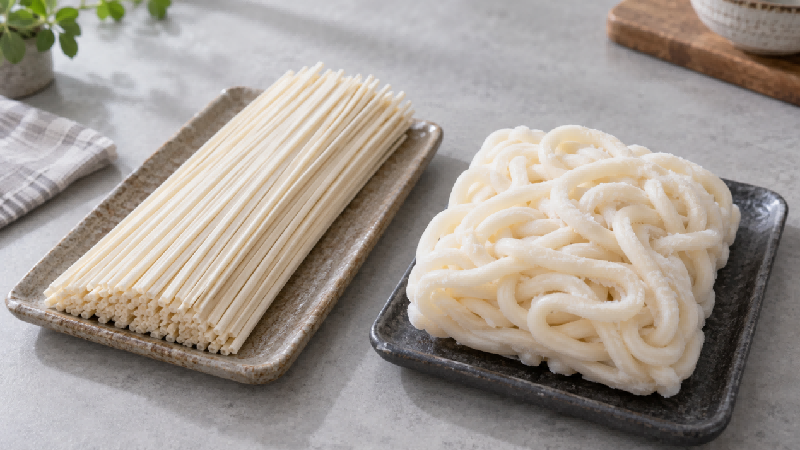
For outlets with high order volumes that emphasize portion-controlled operations, frozen udon noodles are worth serious consideration. Beyond the texture after reheating, evaluate whether the portion size is appropriate, if the product is easy for staff to handle, and how much inventory the existing freezer can accommodate. Chain operators, in particular, should clearly document operational steps to minimize inconsistencies in the final dish across different locations.
Conduct Tests Based on Real-World Orders
Simply tasting a noodle straight out of the pot isn’t enough to determine if a product is suitable for long-term use. A more practical approach is to use the same noodle to prepare both noodle soup and stir-fried noodles: observe how the texture changes after soaking in broth, and check for breakage or sauce adhesion during stir-frying. For outlets offering delivery, taste-test the noodles after letting them sit for the duration of a typical delivery run.
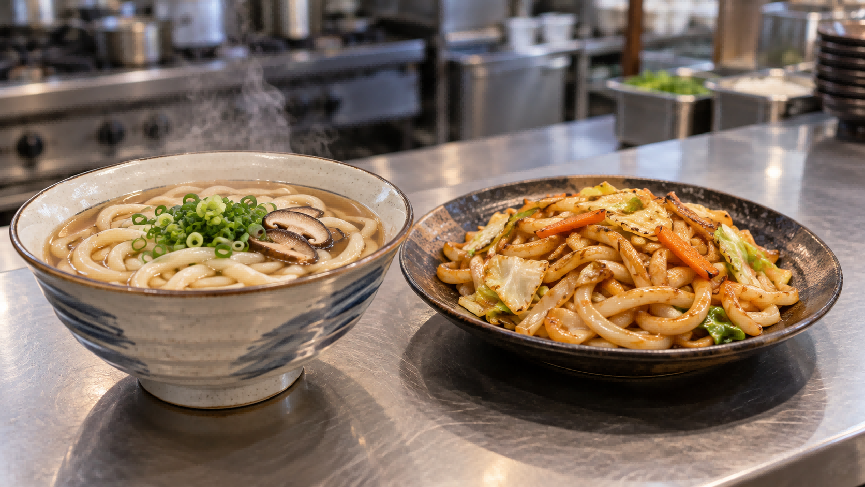
It is recommended that the purchasing team and kitchen staff jointly complete a sample evaluation form, recording the input per portion, preparation time, texture of the finished dish, and waste/loss. Keeping conditions consistent ensures the products can be accurately compared.
Convert Price Quotes into Cost-Per-Portion
Dried and frozen products have different moisture contents, so comparing prices per kilogram can easily lead to misleading conclusions. Instead, calculate the cost per portion based on the actual number of standard servings yielded by a single package, then factor in costs for transportation, storage, and operational waste. This method also makes it easier for distributors to explain the product’s value to foodservice clients.
There is no need to rush into stocking multiple specifications during the initial purchase. Start by selecting a product suited to your primary customer scenarios and conducting a small-batch trial run to gauge repurchase rates and inventory turnover; only then should you decide whether to add other specifications.
Once the product is selected, factor in the restocking schedule. Distributors can set up replenishment alerts based on shipping lead times and weekly customer consumption to avoid placing orders only when stock runs critically low. For restaurant chains planning to switch noodle products, it is advisable to first conduct a trial at a limited number of locations to gather feedback on kitchen operations and customer reception. A phased rollout should follow, accompanied by a plan to use up existing stock and minimize waste.
When inquiring about our udon noodles, please provide details regarding your sales channels, projected usage, storage conditions, and key dishes, as well as any specific packaging and labeling requirements. Providing this information helps clarify the scope of product sampling and reduces the time spent on repeated product selection.
Contact
Beijing Shipuller Co., Ltd
Whats App: +86 13683692063
Web: https://www.yumartfood.com/
Post time: Oct-10-2026