I’ve noticed a rather interesting phenomenon: Chinese people have a special dependence on and affection for “sauces” when cooking.
Whether you’re a seasoned chef in the kitchen or an ordinary person cooking at home, you always need to keep a few signature sauces on hand. A spoonful before stir-frying to flavor the oil, a spoonful when stewing meat to enhance the aroma, and a small dish for dipping at mealtimes—only then does the meal feel complete.
This habit didn’t develop overnight. Going back thousands of years, our ancestors were already using “hai” (meat sauce) and “xi” (vinegar) for seasoning.
Back then, making sauces was mainly to preserve leftover meat and fish. Later, they gradually discovered that sauces fermented from grains like beans and wheat had a richer flavor and could create a wider variety of tastes, thus becoming an indispensable “foundation of flavor” for every household.
1 Northeastern Soybean Paste
Making Northeastern soybean paste requires a lot of patience. The first year, soybeans are boiled, mashed, and made into soybean paste blocks, which are then wrapped in paper and left to ferment.
The following spring, the soybean paste blocks, now covered in beneficial mold, are washed clean, broken into pieces, and added to a fermentation vat. Salt and water are added, and the rest is left to the sun and wind. Every day, a rake is used to “stir” the paste to ensure thorough fermentation.
The resulting soybean paste is dark brown in color, with a savory and rich flavor, and a robust soybean aroma.
In Northeast China, the simplest and most direct way to eat it is with scallions dipped in the paste—a bite of scallion followed by a bite of rice—it’s all about the satisfying experience. It’s also the soul of stews; without a spoonful of soybean paste, the richness and depth of the broth in chicken stew with mushrooms would be halved.
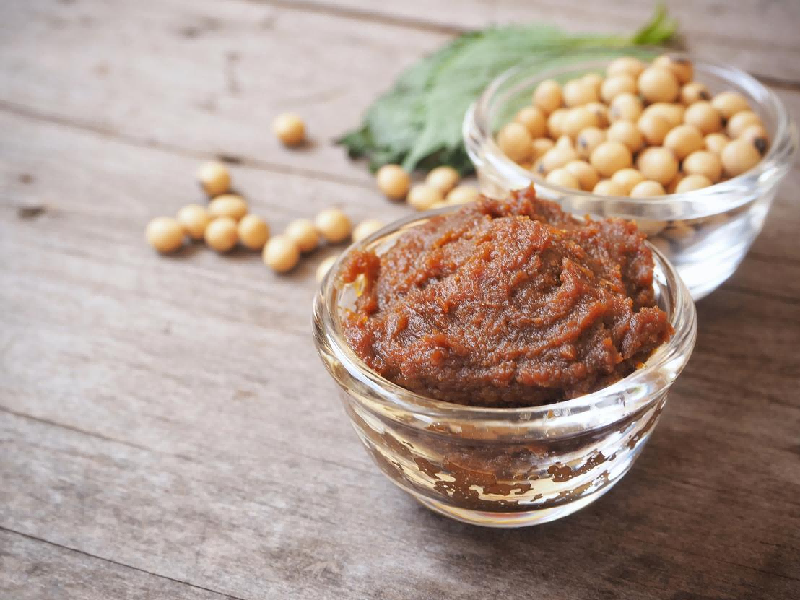
2 Soybean Paste
Soybean paste can be seen as a refined version of Northeast soybean paste, popularized throughout the country.
It also uses soybeans as its main ingredient, but the process is more standardized, resulting in a uniform texture, a prominent savory flavor, and a rich, aromatic savory flavor.
Because of its mellow flavor, unlike some sauces that are too pungent, it’s especially suitable for dishes that require long simmering to allow the flavors to deeply penetrate the ingredients.
For example, in classic braised pork ribs, the rich, savory aroma of the bones and meat is primarily imparted by soybean paste.
3 Pixian Doubanjiang (Pixian Chili Bean Paste)
In Sichuan cuisine, the reigning champion of flavor changes hands, and that title belongs to Pixian Doubanjiang.
Its main ingredients are broad beans and chili peppers. After a long period of sun and dew exposure and fermentation, it turns a reddish-brown, glossy color, and its flavor is a blend of fragrance, spiciness, mellowness, and richness, with a lingering aftertaste.
Calling it the “soul” of Sichuan cuisine is no exaggeration. When stir-frying twice-cooked pork, Pixian Doubanjiang must be used to sauté in hot oil until fragrant, releasing an enticing red oil and complex aroma; only then does the dish truly come alive.
To make good twice-cooked pork, selecting the right meat is the first step. Ideally, use the second cut of pork from the hindquarters, with its distinct layers of fat and lean meat.
Place a whole piece of pork in a pot of cold water with scallions, ginger, and Sichuan peppercorns. Cook until a chopstick can easily pierce it. Remove and let cool, then slice into thin, large pieces.
In hot oil, add chopped Pixian chili bean paste and stir-fry over low heat until the oil turns red and fragrant. Then add the pork slices back in and stir-fry together.
Next, add sweet bean sauce and a little sugar for flavor. Add chopped garlic sprouts and stir-fry quickly over high heat until the garlic sprouts are just cooked through. The pork slices are savory, slightly spicy, and infused with the aroma of the chili bean paste and garlic sprouts. They are rich but not greasy, making them an excellent accompaniment to rice.
4. Dried Yellow Soybean Paste
In old Beijing, dried yellow soybean paste holds an irreplaceable and prestigious position.
It is a solid sauce made from fermented soybeans and flour. It is deep yellow in color, very salty, and has an extremely strong flavor. Before using it, it must be slowly diluted with water or Shaoxing wine. Its most glorious stage is undoubtedly Old Beijing Fried Sauce Noodles.
To make authentic Beijing-style fried sauce, choose pork belly with a good balance of fat and lean meat, diced into small cubes, not minced. Mix dry yellow soybean paste and sweet bean sauce in a roughly 3:1 ratio with water to form a thin paste.
Put plenty of oil in a wok. First, add the diced fatty pork and render the fat over low heat. Then add the diced lean pork and stir-fry until it changes color. Pour in the diluted sauce and turn the heat to the lowest setting to slowly “fry.”
This process requires patience. Stir constantly in one direction with a spatula to prevent burning.
You’ll see the water in the sauce slowly evaporate, the oil begin to separate from the sauce, and the sauce will darken in color and become more fragrant.
Once the sauce and oil have completely separated, and a clear layer of oil floats on the surface, the sauce is ready. Serve cooked hand-pulled noodles with seven or eight toppings, including shredded cucumber, shredded radish, bean sprouts, and soybeans. Pour two spoonfuls of sauce over it, mix it all together, and the taste is the soul of Beijing.
5 Sesame Paste
Sesame paste is synonymous with rich aroma. It’s made by finely grinding high-quality white sesame seeds after roasting, resulting in a fragrant aroma and smooth texture.
It’s not only the perfect accompaniment to hot pot in northern China, but also the finishing touch to many local snacks. The most famous example is Wuhan hot dry noodles.
Hot dry noodles use alkaline noodles, which are cooked until 80% done, then drained, spread out, drizzled with sesame oil, and quickly cooled and shaken with a fan – this is called “dusting the noodles.”
To prepare it, blanch the cooled noodles in boiling water for about ten seconds, quickly drain, and place in a bowl.
Seasoning is key: first, drizzle with light soy sauce and dark soy sauce, then pour on the crucial two spoonfuls of sesame paste (diluted with sesame oil). Next, add chili oil, diced radish, pickled cowpeas, chopped green onions, and a little balsamic vinegar according to preference.
Quickly mix the noodles and all the seasonings with chopsticks, ensuring each noodle is evenly coated with the rich sesame sauce. The noodles are chewy and the sauce is rich and flavorful, making it a staple breakfast for Wuhan locals.
Celia
Beijing Shipuller Co., Ltd
WhatsApp: +86 136 8369 2063
Web: https://www.yumartfood.com/
Post time: Mar-25-2026